Wood moisture measurement is a critical step in quality control at any sawmill or lumber company. Even so, it is common to see operators placing the meter on the first “accessible” spot on the board, often right on top of a knot or a visible crack. It is a quick move, but it can undermine every decision made from that number: releasing a batch for shipping, adjusting kiln drying time, or accepting or rejecting a load of raw material.
This article explains, in plain terms, why knots and cracks distort wood moisture measurement and how that affects quality control and production at lumber mills and forest-based industries.
The wood moisture measurement problem in one sentence
Knots and cracks do not represent the actual moisture of the surrounding wood. Measuring wood moisture at those points is like taking a patient’s temperature by touching the thermometer to their clothes: you get a number, but it does not describe what you need to know.
What happens to the wood structure at knots
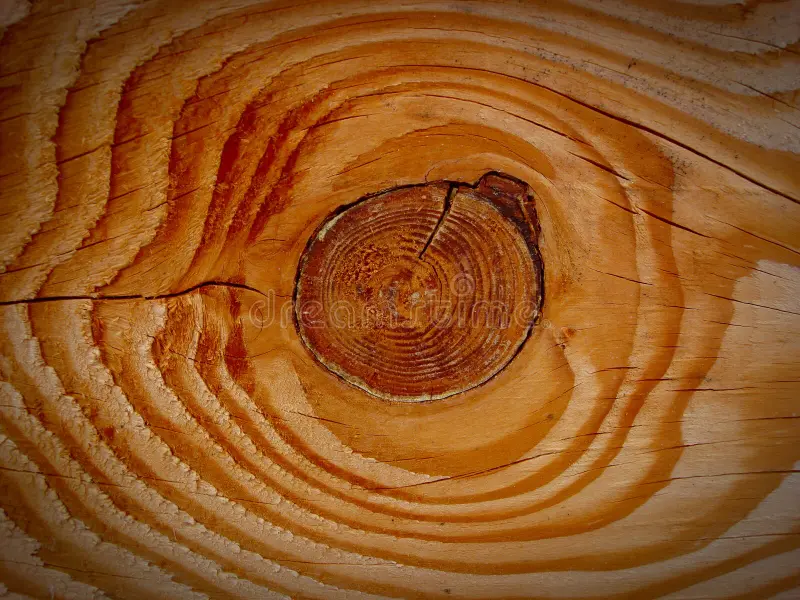
A knot is the base of a branch embedded in the trunk. There, the wood structure differs significantly from normal wood:
- Much higher density. A knot is typically 20% to 40% denser than the surrounding wood, because its fibers grow in different directions and are more tightly packed.
- Altered grain orientation. Instead of following the trunk’s longitudinal axis, knot fibers run at varying angles, creating a material with different electrical and hygroscopic behavior.
- Resin and extractives. Softwoods in particular accumulate resin in knots, which changes the material’s electrical conductivity, the very principle behind most resistance-type moisture meters.
- Different drying rate. Being denser and less porous, a knot dries and takes up moisture at a different rate from the rest of the board, often ending up drier at the surface even when the core of the board is still wet.
What happens when measuring wood moisture on cracks
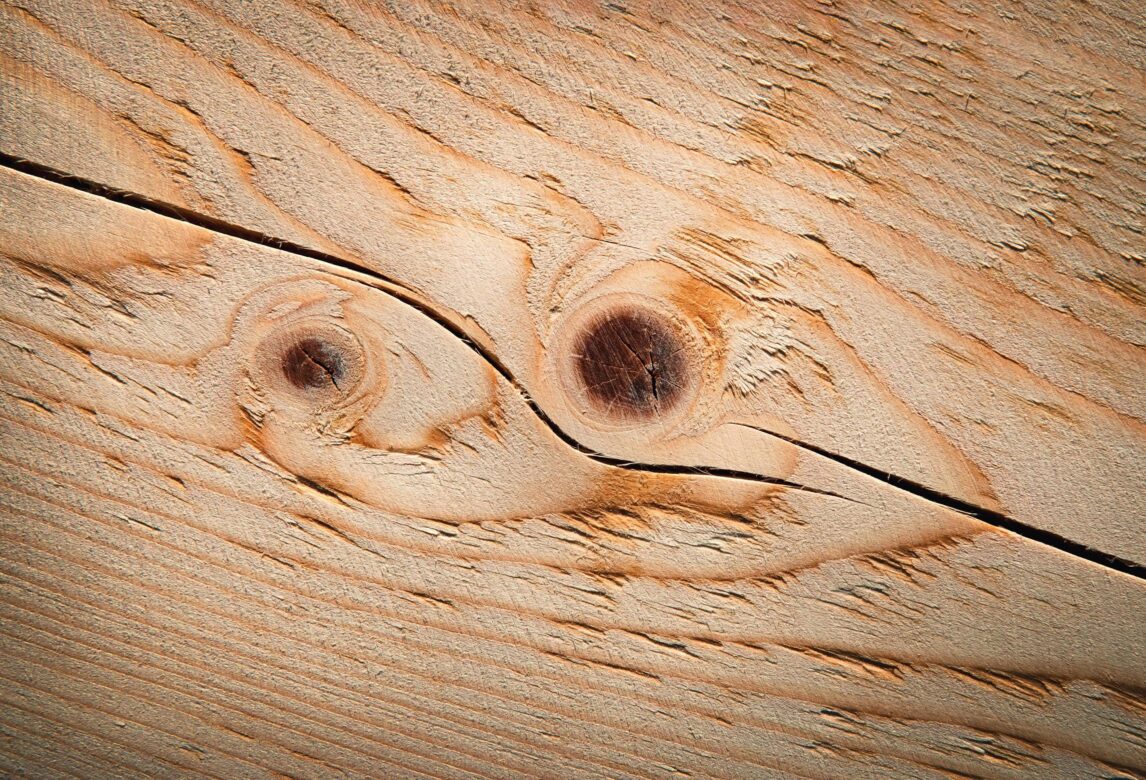
Cracks (checks and splits) appear because of internal drying stresses, handling impacts or the tree’s genetic traits. At these points:
- The material is physically discontinuous. Where there is a crack, there is air. Capacitive and radio-frequency sensors, which depend on the dielectric constant of the medium, see a mix of wood and air, which produces unstable and unpredictable readings.
- Irregular electrical contact with the electrodes (pins). On contact meters, the pins can drop partly into the gap, reducing the contact area and producing readings that are either artificially low or artificially high, depending on the crack’s orientation.
- Moisture builds up at the edges. Moisture often collects along the edges of a crack by capillary action, creating a reading point much higher than the board’s average.
Why moisture sensors get it wrong in these areas
| Sensor technology | Effect of knots | Effect of cracks |
|---|---|---|
| Resistance (pins/electrodes) | High conductivity from resin and density produces unstable readings | Incomplete contact or contact concentrated at the edges, causing false peaks |
| Capacitive / RF (pinless) | Density and chemical composition change the dielectric constant, distorting the calibration curve | Air pockets lower the reading artificially and inconsistently |
| Microwave (in-line, industrial) | Signal scattering in heterogeneous areas reduces repeatability | Irregular signal reflection at discontinuities in the material |
All these technologies share the same issue: any wood moisture meter is calibrated for sound, homogeneous material. Knots and cracks make the sensor “read” a material different from the one it was calibrated for.
Typical reading deviation by area
The values below are illustrative reference ranges based on field experience; they vary with species, density and sensor type. They do not replace a calibration specific to each application.
| Measurement area | Typical deviation from the true value (percentage points) |
|---|---|
| Clear, defect-free wood | 0 to 2 |
| Near knots | 3 to 8 |
| On knots | 8 to 20 |
| Near cracks | 4 to 10 |
| On cracks | 10 to 25 |
Practical consequences for the operation
1. Wrong batch classification. A board can be classified as “dry” because of a single reading on a drier knot, while the core of the piece is still out of spec.
2. Kiln shut down at the wrong time. Sensors placed on knots tend to show faster drying than is actually happening, leading to an early end of the cycle.
3. Rework and customer non-conformities. Wood released on the basis of an optimistic reading fails later, through warping, post-drying checks or rejection at the customer’s quality control.
4. Loss of trust in the instrument. The problem usually lies in the sampling point chosen, not in the meter.
How to measure wood moisture correctly
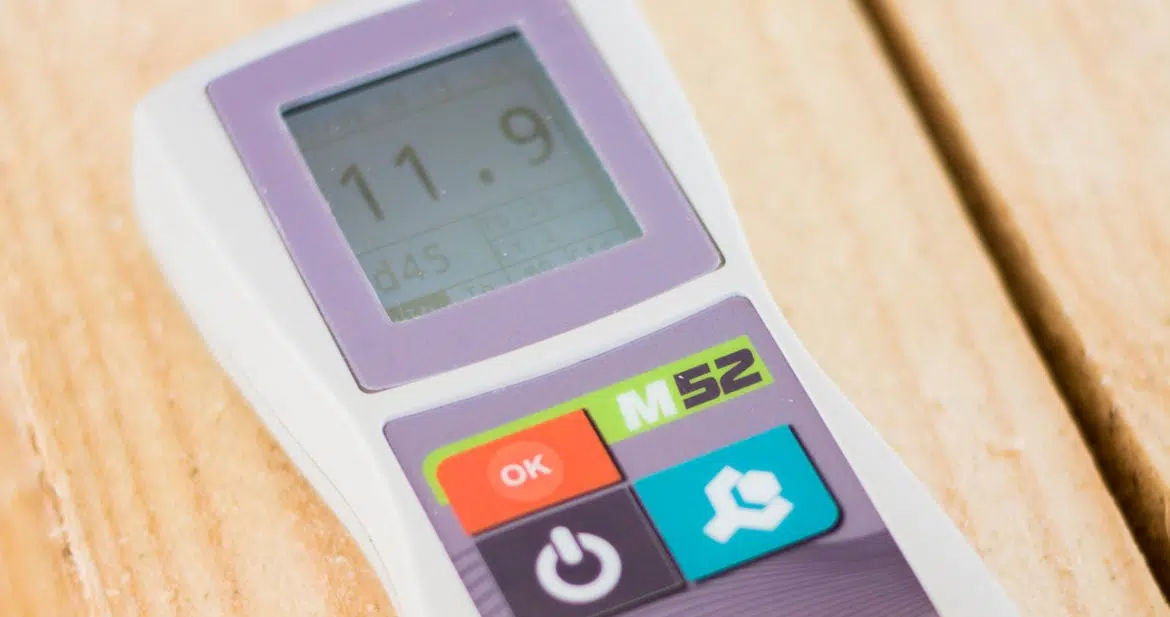
Reference standards such as ASTM D4444 (standardization and calibration of hand-held moisture meters) and ASTM D4442 (direct moisture content measurement of wood), along with meter manufacturers’ guidance, converge on similar recommendations:
| Recommended practice | Why |
|---|---|
| Measure on wood free of knots, cracks, resin and pith | Ensures the reading reflects the homogeneous material that will be processed or delivered |
| Take several readings on the same board and use the average | Reduces the impact of natural moisture variation along the board |
| Keep a minimum distance from visible defects (at least 3 to 5 cm from knots and cracks) | Avoids the defect’s electrical and structural zone of influence |
| Standardize the sampling point in the batch (e.g. always at 1/3 of the board length) | Keeps readings comparable over time and between operators |
| Record and discard readings far from the batch average | Signals that the point measured probably coincided with a defect |
| Calibrate the meter for the right species and density range | Each species has its own curve relating sensor signal to actual moisture |
If you are still unsure which meter to use in your process, we have published a complete guide on choosing the best wood moisture meter for different applications, and an article on how to determine wood moisture content that explains the main measurement methods. To understand why the moisture of each board matters so much after the kiln, see lumber moisture content: the hidden problem in the sawmill.
For quick inspections when receiving wood or on the shop floor, the M52 portable wood moisture meter is one of the solutions that prevents exactly this kind of sampling error, with simple, accurate readings away from defect zones.
Where automation helps eliminate human error
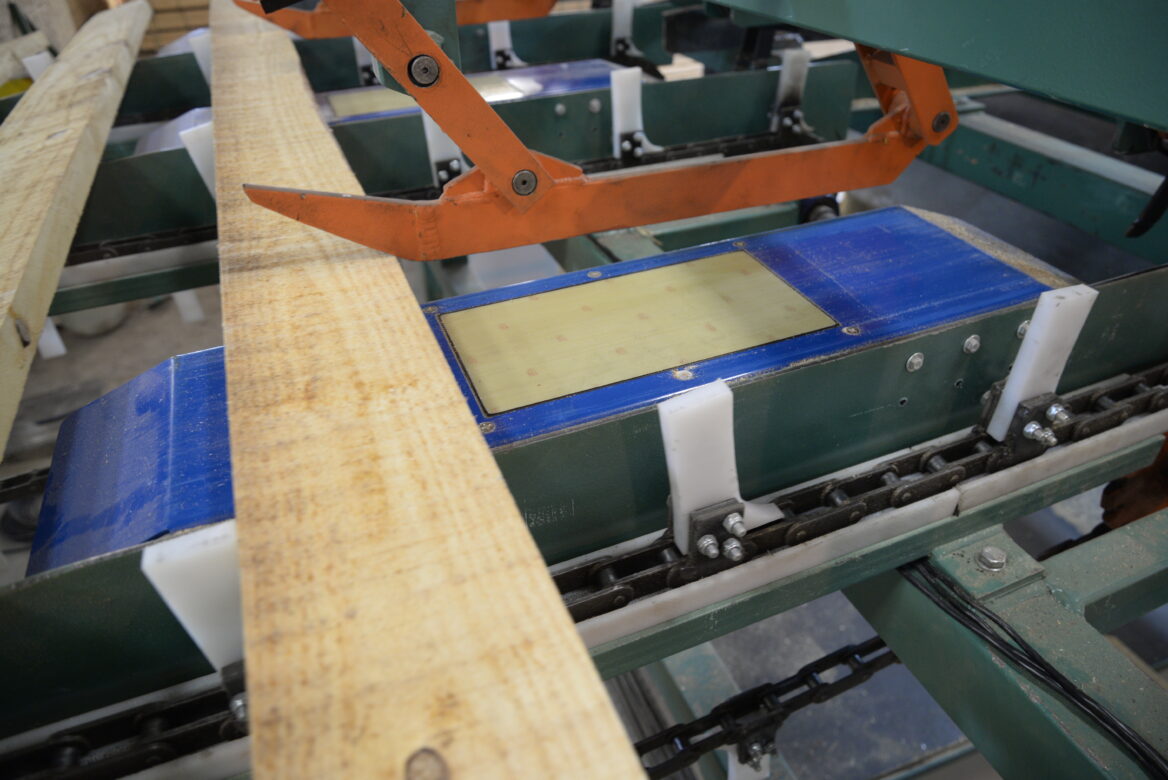
In manual operations, avoiding knots and cracks when measuring wood moisture depends on the operator’s judgment and attention, which is hard to keep consistent over long shifts and high board volumes. Continuous measurement solutions such as the UmiLine T transverse in-line moisture meter reduce reliance on a single, manually chosen reading point by checking the whole board at high speed and in real time.
This kind of automation also fits a broader data management picture at the sawmill. We covered this in Sawmills: automation and modernization, showing how traceability and real-time moisture control are becoming a market requirement rather than a differentiator.
Conclusion
Measuring wood moisture on a knot or crack is not a minor execution detail; it is a methodological error that undermines every decision that depends on that number. The recommendation is easy to apply and to train any team on: always choose sound wood, away from visible defects, take several readings and be suspicious of any value far outside the batch pattern.
Need to standardize wood moisture measurement in your operation? Talk to the Marrari team and explore our wood moisture meters.
References
- ASTM International. D4444: Standard Test Method for Laboratory Standardization and Calibration of Hand-Held Moisture Meters. https://store.astm.org/d4444-13r18.html
- ASTM International. D4442-20: Standard Test Methods for Direct Moisture Content Measurement of Wood and Wood-Based Materials. https://www.astm.org/Standards/D4442.htm
- Wagner Meters. Wood Moisture Meter Buying Guide. https://www.wagnermeters.com/moisture-meters/wood-info/pin-moisture-meter/
- Bessemeter. Wood Moisture Meter FAQs. https://www.bessemeter.com/learn-more/
- ScienceInsights. How to Measure Moisture Content of Wood Accurately. https://scienceinsights.org/how-to-measure-moisture-content-of-wood-accurately/
- Kett Electric Laboratory. Moisture Meter Best Practices. https://blog.kett.com/moisture-meter-best-practices
Want to apply this in your plant?
Talk to a Marrari specialist on WhatsApp or see the right solution for your process.