
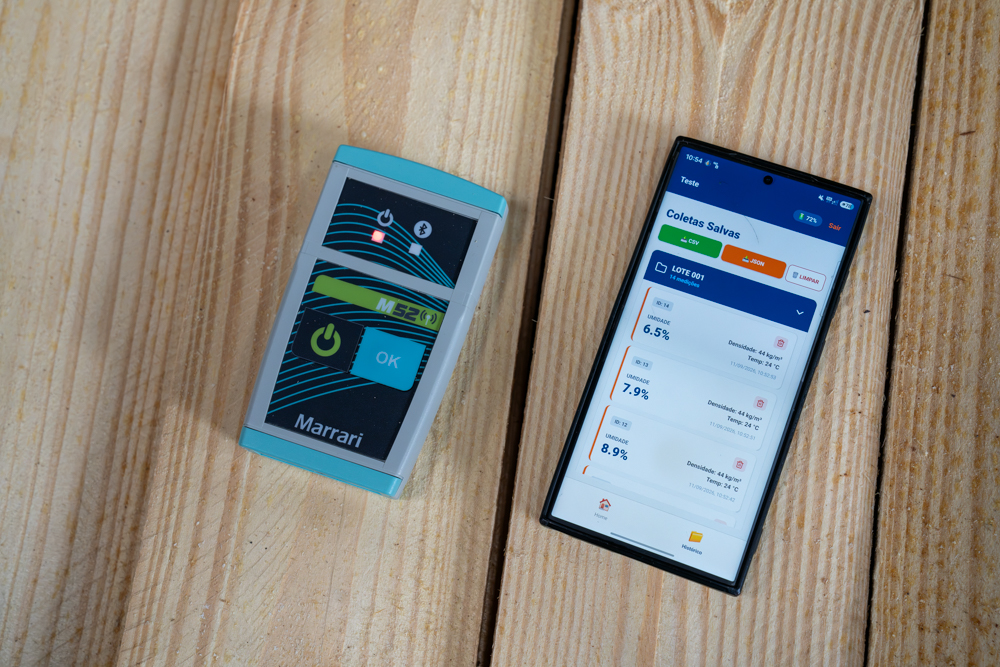
Anyone who works with wood, grain or biomass knows that moisture determines product quality, drying costs and even business margins. A Bluetooth moisture meter fits right into that picture: it sends the meter reading to your phone, organizes the data in real time and removes much of the manual work that is still part of many operations.
In this article, you will learn what a Bluetooth moisture meter is, what real benefits it brings to day-to-day industrial work and what to evaluate before adopting this technology.
What is a Bluetooth moisture meter?
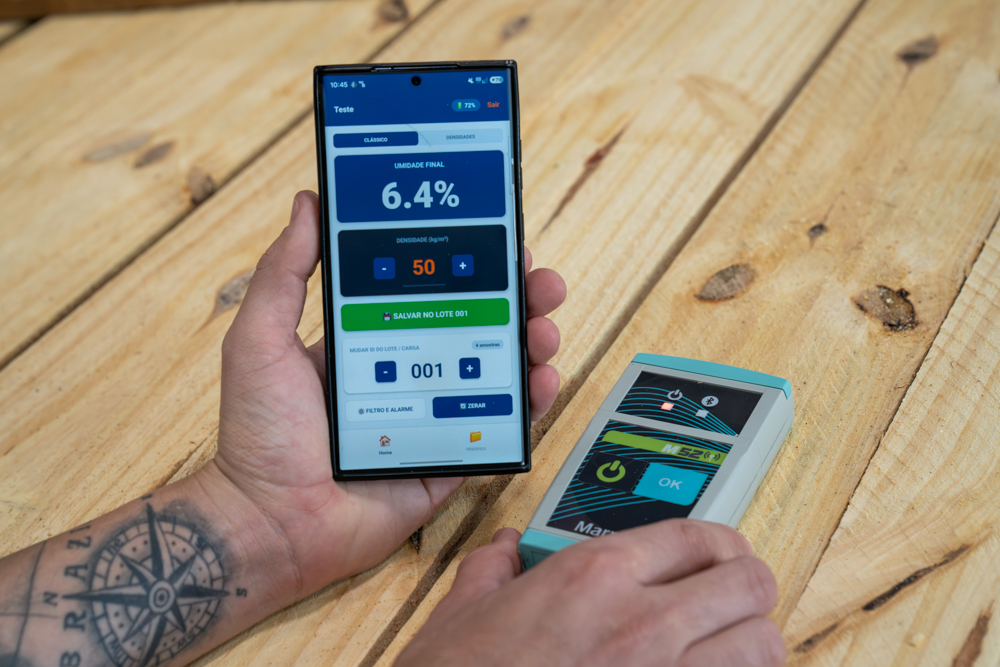
It is a portable moisture meter that communicates with a smartphone app over Bluetooth Low Energy (BLE). Instead of relying only on the meter’s display and paper notes, the operator follows the measurement on the phone screen, saves readings with one tap and organizes everything by batch.
The measuring principle is the same as the portable meter the industry already knows. What changes is what happens after the reading: the data is born digital, with date, time and identification, ready to be looked up and shared.
1. Real-time readings in the palm of your hand
With the meter paired to the phone, the operator sees the moisture value, battery level and measurement settings in the app, without having to walk up to the device or stop working to check the display. In yards, warehouses and kilns, this saves time and reduces reading errors.
2. No more paper notes
Manual transcription is one of the biggest sources of error in moisture control. A miscopied number, a lost sheet or illegible handwriting can compromise the traceability of an entire batch.
With digital logging, every reading is saved automatically with date, time and batch. You can save from the app or with the button on the meter itself, with confirmation by vibration and beep, which speeds up the routine for anyone measuring dozens of samples a day.
3. Batch organization and history always at hand
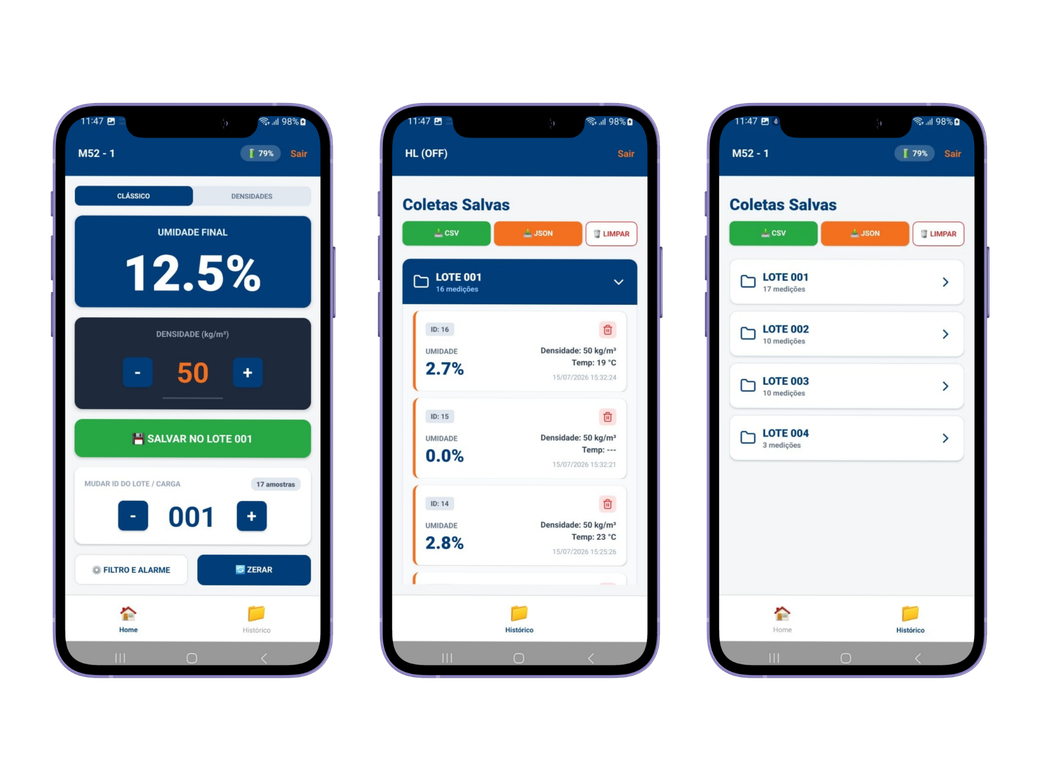
A good app groups readings into batches, keeps the history in chronological order and lets you look up past measurements at any time, even without a connection to the meter. On the phone, the number of readings and batches is not a practical limitation for the operation.
This changes the conversation with customers and internal audits. Instead of just stating that the wood was within range, the company can show the record.
4. Out-of-range moisture alarms
You can set minimum and maximum moisture limits. When a reading falls outside the range, the app alerts with vibration and sound. In practice, the operator notices the deviation at the moment of measurement, before the material moves on to the next stage.
For anyone controlling drying, this immediate alert helps avoid problems such as checks, warping and losses from over- or under-drying.
5. Data ready to export and analyze
Records can be exported in formats such as CSV and JSON and shared via WhatsApp, email or the cloud. This opens the door to deeper analysis: comparing batches, tracking drying progress over time and spotting patterns that go unnoticed in hand-made spreadsheets.
This is where the app and management software complement each other. The phone handles data collection in the field, in real time. Software such as Marrari’s UmiData handles data analysis and management in the office.
6. Faster day-to-day operations
A Bluetooth meter cuts steps. The operator measures, saves and moves on to the next sample, without stopping to write and without retyping later. In operations that measure many pieces per shift, these small gains add up in team productivity and data reliability.
7. More control over quality and cost
Off-spec moisture leads to rework, returns and lost customer trust. Measuring more often, with better records and less effort tends to lead to better decisions on drying, storage and shipping. The result is a more predictable process with less wasted energy, time and material.
Comparison: conventional meter vs. Bluetooth meter
| Criterion | Meter with display only | Meter with Bluetooth and app |
|---|---|---|
| Reading | On the meter display | On the meter display and phone screen |
| Logging | Manual notes | Saved automatically with date and time |
| Organization | Spreadsheets and paper | Batches and history in the app |
| Alerts | Depend on operator attention | Range alarm with vibration and sound |
| Sharing | Retyping later | Export to CSV and JSON |
| Traceability | Limited | Digital record by batch |
What to evaluate before adopting a Bluetooth moisture meter
- Works without internet: in yards and rural areas, mobile data coverage is patchy. Ideally the app works offline and lets you check the history at any time.
- Integration with your management system: data needs to leave the phone easily, in formats your software can import.
- Battery and ruggedness: the device must withstand field use, with a clear battery indicator in the app.
- Technical support: choose a manufacturer that offers service and diagnostics and knows your application.
Bluetooth moisture meters in the Marrari line
Marrari has been making portable moisture meters for decades, serving industries such as wood, grain, biomass and sanitation. Bluetooth technology is gradually reaching the company’s meter line, always as an added layer on top of the reliability the industry already knows, and it works together with UmiData.
To get the most out of any meter, follow good measurement practice, such as avoiding readings on knots and cracks. If you want to know which meter best fits your operation, Marrari’s technical team can help assess your process and recommend the right solution.
Frequently asked questions
Does a Bluetooth moisture meter need internet to work? No. The meter and phone communicate over Bluetooth, and the history can be viewed even without a connection to the device.
Does the app replace management software? No. The app is the field layer, for real-time reading and logging. Data analysis and management remain in the software, such as UmiData.
Can I export readings to a spreadsheet? Yes. Readings can be exported to CSV and JSON and shared via WhatsApp, email or the cloud.
Is a Bluetooth moisture meter only for wood? Wood is the most common application, but digital logging and alarms are useful in any process where moisture must be closely tracked.
Conclusion
A Bluetooth moisture meter does not change what is measured; it changes how the data is used. Real-time readings, automatic logging, alarms, batch history and easy export turn a manual task into a reliable source of information for better decisions.
Want to apply this in your plant?
Talk to a Marrari specialist on WhatsApp or see the right solution for your process.