
Brazil’s pulp and paper industry is one of the most competitive in the world, thanks to a climate and soil that favor planted forests and to steady investment in research and technology. In 2025, Brazil produced a record 29.4 million tons of pulp (up 6.9% from 2024) and 11.3 million tons of paper, according to Ibá, the Brazilian Tree Industry association [1]. Sector exports reached US$ 14.9 billion, or 4.3% of Brazil’s trade balance [1].
At that scale, small variations in paper moisture turn into large losses: energy spent on drying, off-spec paper and machine downtime. That is why understanding where water leaves the process, and how to measure it, is a core part of quality control.

How paper is made: from log to sheet
Paper grades vary by process and end use, but the basics of production are similar. Debarked logs go to the chipper, which turns them into wood chips. The chips are screened and sent to the digester, where the wood is cooked and the fibers separate. The pulp is then screened and washed and, depending on the paper’s end use, bleached. Refining comes next, and the pulp is held in the stock tank until it moves on to the paper machine.
At this point, the stock is almost all water. The water-to-fiber ratio varies with the process, but at the paper machine headbox consistency is typically below 1%, meaning more than 99 parts water for every part fiber.
Where water is removed on the paper machine
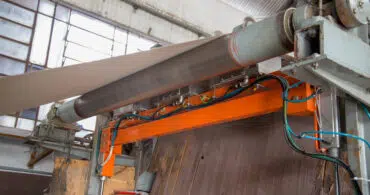
The paper machine’s job is to remove water from the sheet, and it does so in three stages. In the forming section, water drains through the wire by gravity and vacuum. In the press section, it is removed by mechanical compression. In the dryer section, it evaporates with heat from steam-heated drying cylinders.

The forming section removes about 95.4% of the water, the press section about 3.2% and the dryer section only 1.4% [2]. That last share is small, but it is the most expensive to remove, because it depends on steam.
Why measure paper moisture
Keeping paper moisture within specification is costly. The main costs include running the paper machine, the energy and vacuum used for dewatering and, above all, steam generation for drying. Paper that leaves the machine too wet loses strength and can curl; paper that is too dry means wasted steam and a brittle sheet. Accurate moisture measurement is what lets you adjust the process at the right point. See the effects of these variations in detail in paper moisture control: how to prevent production losses.
How to measure paper moisture
Marrari offers solutions to measure and control moisture and, with it, the costs of this process. For in-line measurement, UmiPaper reports moisture in real time during production, using a capacitive sensor. For spot checks, the M71 portable meter can be used on paper. With support from our UmiLab and After-Sales teams, you can create calibration curves specific to your product, so you get your material’s moisture content instantly, with a reliable value.
Bruno Daldin Leite
Industrial Wood Engineering student – UFPR (Federal University of Paraná).
Technician at the UmiLab laboratory, Marrari Automação Industrial
Want to apply this in your plant?
Talk to a Marrari specialist on WhatsApp or see the right solution for your process.
References
[1] Ibá – Indústria Brasileira de Árvores, cultivated tree sector data, January to December 2025 (with Comex Stat trade data), published by Sinpacel (in Portuguese). https://www.sinpacel.org.br/wp-content/uploads/2026/04/dados-do-setor-florestal.pdf
[2] Alan Sulato de Andrade and Umberto Klock, paper machine diagram and water removal by section.