Among the properties of wood, moisture, in both chip piles and log piles, is fundamental to logistics planning in production chains: it affects harvest timing, the volume to be transported, the number of trucks needed to haul the raw material, how long it is stored in the field or yard, and more.
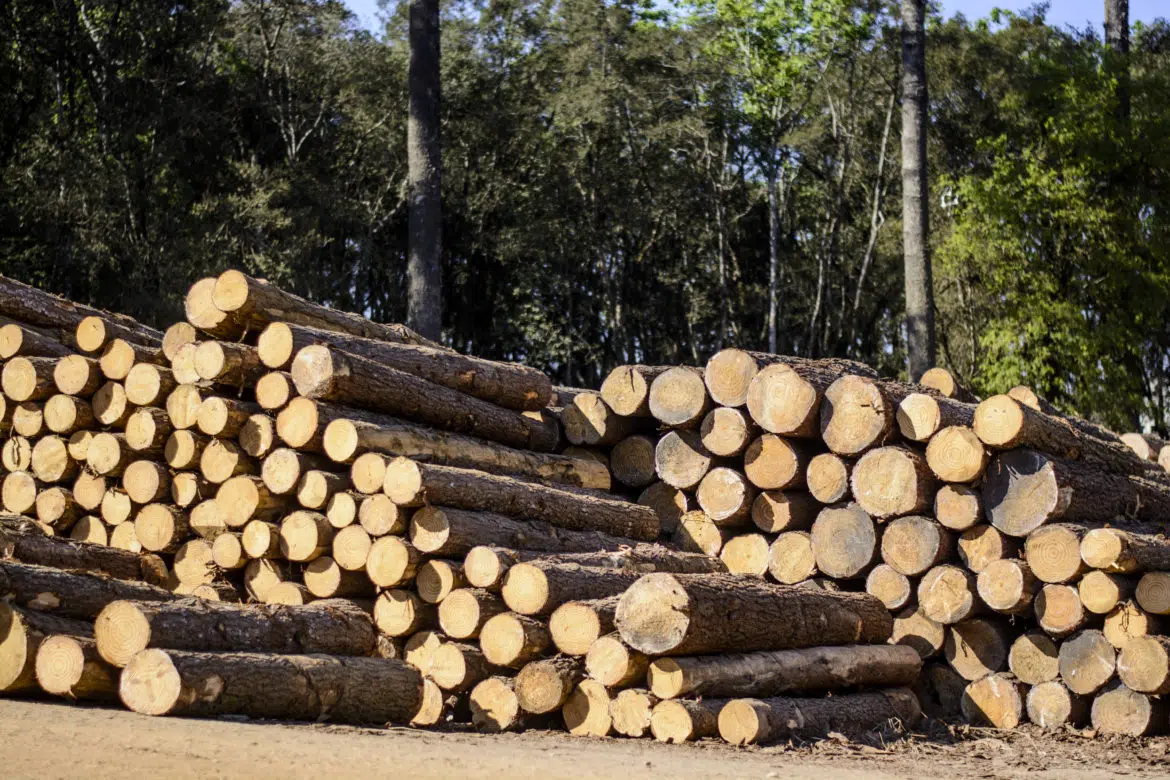
At felling, moisture (wet basis) can reach 60%. That is why logs are very often stored in the field for a variable period, set according to the climate, the transport distance and the ideal moisture range for the biomass boiler.
The experiment: open-air drying of eucalyptus logs
One way to monitor this change in log moisture is with scales, but they are not practical to operate in the field. This work presents, in simple and summary form, the drying curve of Eucalyptus urophylla logs, clone AEC 0144, 6.2 m long with an average DBH of 16.9 cm. The scales were installed at the School of Agricultural Sciences (FCA/Unesp) in Botucatu, São Paulo, Brazil, and the piles of long logs with bark were left to dry in the open, uncovered. Drying was monitored over two 160-day periods: a dry one (autumn and winter) and a rainy one (spring and summer).
Results
| Period | Initial moisture | Moisture after 160 days |
|---|---|---|
| Dry (autumn and winter) | 54.2% | 31.1% |
| Rainy (spring and summer) | 53.9% | 36.4% |
When drying logs, environmental factors such as temperature, relative humidity and wind speed strongly influence how much water the wood loses or gains.
This variation in moisture has a major impact on the forestry chain, transport and power generation: the difference shown can change the unit cost of energy by up to 33% for a thermal power plant located 100 km from the plantation.
Related products
- Umilog M65 multi-purpose portable moisture meter
- M51 portable wood moisture meter
- M52 portable wood moisture meter
Authors
Prof. Dr. Humberto de Jesus Eufrade-Júnior
Prof. Dr. Saulo P. S. Guerra
School of Agricultural Sciences – Unesp
Bioenergy Research Institute – IPBEN
Further reading (in Portuguese): repositorio.unesp.br/handle/11449/182137
Want to apply this in your plant?
Talk to a Marrari specialist on WhatsApp or see the right solution for your process.