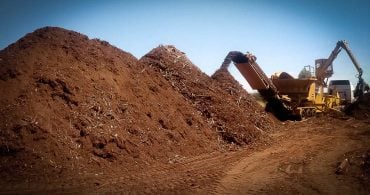

Both how and how long fuel is stored cause changes in its moisture and, as a result, in the amount of energy (calorific value) it holds.
Several studies show how biomass properties vary under different storage set-ups: covered or uncovered, with or without a floor, and so on.
Here I want to highlight one variable that biomass power producers can control well: yard time.
Yard time: natural drying and degradation
Today it is very rare for chips, firewood, sugarcane bagasse or agricultural residues to be traded without the target moisture being agreed in advance. Fuel is bought with a known amount of water and then stored. But there is no way to keep that moisture indefinitely: it will change.
In the first months of storage, especially for chips with their large exchange surface, natural drying takes place. Free water is usually lost easily and the fibre saturation point (FSP) is reached. From then on, drying gets slower and slower and, with luck, the material dries down to the equilibrium moisture content of wood in its region. I say “with luck” because biodegrading agents are very likely to attack before then. For fungi and bacteria in particular, the FSP seems to be the perfect moment to strike.
If there is an ideal time to use the biomass, getting the most from the kcal/kg stored in the yard, it can be found by measuring moisture quickly, cheaply and continuously: at what point does drying stop and degradation take over? At the FSP (about 28% to 30% on a dry basis, or 22% to 23% on a wet basis)? Somewhere else?
Transport
- In Brazil, biomass freight is usually paid per cubic metre per kilometre.
- Except for pellets and briquettes, biomass is mostly transported and traded at 30% to 50% moisture on a wet basis, that is, above the FSP.
- Above the FSP, wood does not change volume when it gains or loses water.
Hauling a 100 m³ load of chips at 30% moisture costs the same as a 100 m³ load at 50% moisture. Both take up the same volume, but the difference can be tonnes of water adding unnecessary logistics cost.
Calorific value and trade
I previously used a metaphor in this article (in Portuguese) to show how moisture governs the biomass trade. Here are just a few reminders:
- In many regions of Brazil, biomass is bought by mass, so wet fuel is more expensive material.
- The water bought along with the fuel has to evaporate before combustion and energy generation really begin.
- The impact of poor moisture control on energy generation is not linear: it grows at every stage, from transport to combustion. See the example below.
The image shows a simulation* of the energy impact in this situation: a load of 40 tonnes of eucalyptus chips (HHV of 4,525 kcal/kg) at 40% moisture was contracted (STANDARD), and 40 tonnes of chips at 50% moisture were delivered (ACTUAL).
*Screen from the Umidata software (Marrari, Brazil) that calculates moisture-based discounts and bonuses on the biomass price.

The contracted scenario (STANDARD) would mean 24 tonnes of dry matter and 16 tonnes of water, with about 91 Gcal of useful energy (after the energy needed to evaporate the water).
The ACTUAL scenario means only 20 tonnes of dry matter and 20 tonnes of water, with about 72 Gcal.
The gap is not just 10 moisture points (from 40% to 50%): it is from 91 to 72 Gcal, or 21% less energy purchased.
Other variables
There are of course many other important variables that can be controlled to ensure biomass quality: density, particle size, ash content, chemical composition… This article focuses on moisture because it is closely linked to all the others, and monitoring it tends to make the rest easier to track and control.
Related products
Author: Elisa Pizzaia Goltz, Industrial Wood Engineer (UFPR, 2014), MSc in Forest Engineering (UFPR, 2018), quality and technical manager at Marrari Automação’s Umilab laboratory
Want to apply this in your plant?
Talk to a Marrari specialist on WhatsApp or see the right solution for your process.