
Biomass is now one of the main renewable energy sources for industry, agribusiness and distributed generation. Whether as wood chips, sugarcane bagasse, rice husk, pellets or other agricultural residues, biomass has its own characteristics that directly affect its performance as a fuel. One of the most important, and most often underestimated, is bulk density.
This article explains, in practical and technical terms, what biomass bulk density is, why it matters to operators, engineers and plant managers, and how controlling it affects the whole process, from transport to combustion efficiency in the boiler.
What is biomass bulk density?
In practice, bulk density is the ratio between the weight of a material and the total space it occupies, including the voids between particles.
This matters especially for biomass because the material is irregular: wood chips, for example, come in varied shapes with air pockets between them. Unlike liquids or compact solids, biomass contains a lot of empty space, which adds volume without adding mass.
Basic formula

Simple example
- A truck loaded with wood chips may hold 10 m³.
- If the load weighs 2,500 kg, the bulk density is:

That is, 250 kg/m³. This figure is essential for knowing how much actual fuel is being transported or stored, not just how much “space” it takes up.
Why does bulk density matter day to day?
1. Logistics planning
A common mistake is to look only at the visible volume of biomass. Two trucks that look equally “full” can carry very different amounts of energy, depending on the bulk density of the material.
Real impact for operators:
- Low-density loads mean more trips to move the same amount of energy.
- Very dense loads, on the other hand, can exceed weight limits, raising legal and mechanical risks.
2. Storage and inventory management
Silos, biomass yards and automatic feed systems depend on accurate capacity estimates. A wrong bulk density figure can lead to:
- Stock that “runs out early”.
- Oversized storage areas.
- Irregular feed to production lines.
3. Combustion efficiency and power generation
Industrial boilers are designed to burn a specific mass of fuel per unit of time to generate steam or thermal energy steadily.
If biomass is fed by volume alone (m³/h), without accounting for density, the result can be:
- Incomplete combustion (low energy efficiency)
- Swings in steam generation (affecting downstream processes)
- Higher emissions (from poor combustion)
For the boiler operator, this means:
- More manual adjustments to control combustion.
- Difficulty keeping pressure and temperature constant.
- Higher risk of shutdowns or corrective maintenance.
Main factors that affect biomass bulk density
Biomass density can vary widely, even within the same type of material. The main factors are:
| Factor | Effect |
|---|---|
| Moisture | Wet biomass weighs more for the same volume. |
| Particle size | Larger chips create more voids. Ground biomass tends to be denser. |
| Particle shape | Irregular particles settle differently, which affects packing. |
| Biomass type | Different materials (hardwood, bagasse, sawdust) have different natural densities. |
| Compaction | Compression during transport or storage changes bulk density. |
How do you measure biomass bulk density in practice?
Traditional methods
Bulk density used to be measured by hand:
- A representative biomass sample was collected.
- Its volume was measured (in standard containers).
- The sample was weighed.
- The density was calculated.
Limitations:
- Slow work, prone to human error.
- Hard to capture the real variability of the biomass flow.
Modern technology: Marrari solutions
Advances in industrial automation brought equipment that measures quickly and accurately, in the field or in-line. Marrari Automação offers some of the most efficient and recognized solutions on the market:
M75D: moisture and bulk density meter
The M75D is a portable instrument designed for industrial applications that need to control biomass moisture and bulk density at the same time.
- Measures in the field, at receiving or in the yard, with samples of up to 35 liters.
- Its built-in scale calculates bulk density along with the moisture reading.
- Stores up to 5,000 readings and transfers data to the UmiData software for batch control and traceability.
- Helps keep combustion stable, optimizing fuel use and reducing pollutant emissions.
Direct benefits for the boiler operator:
- Reliable data for each batch to set the feed rate.
- Less time spent on manual corrections.
- More stable steam temperature and pressure.
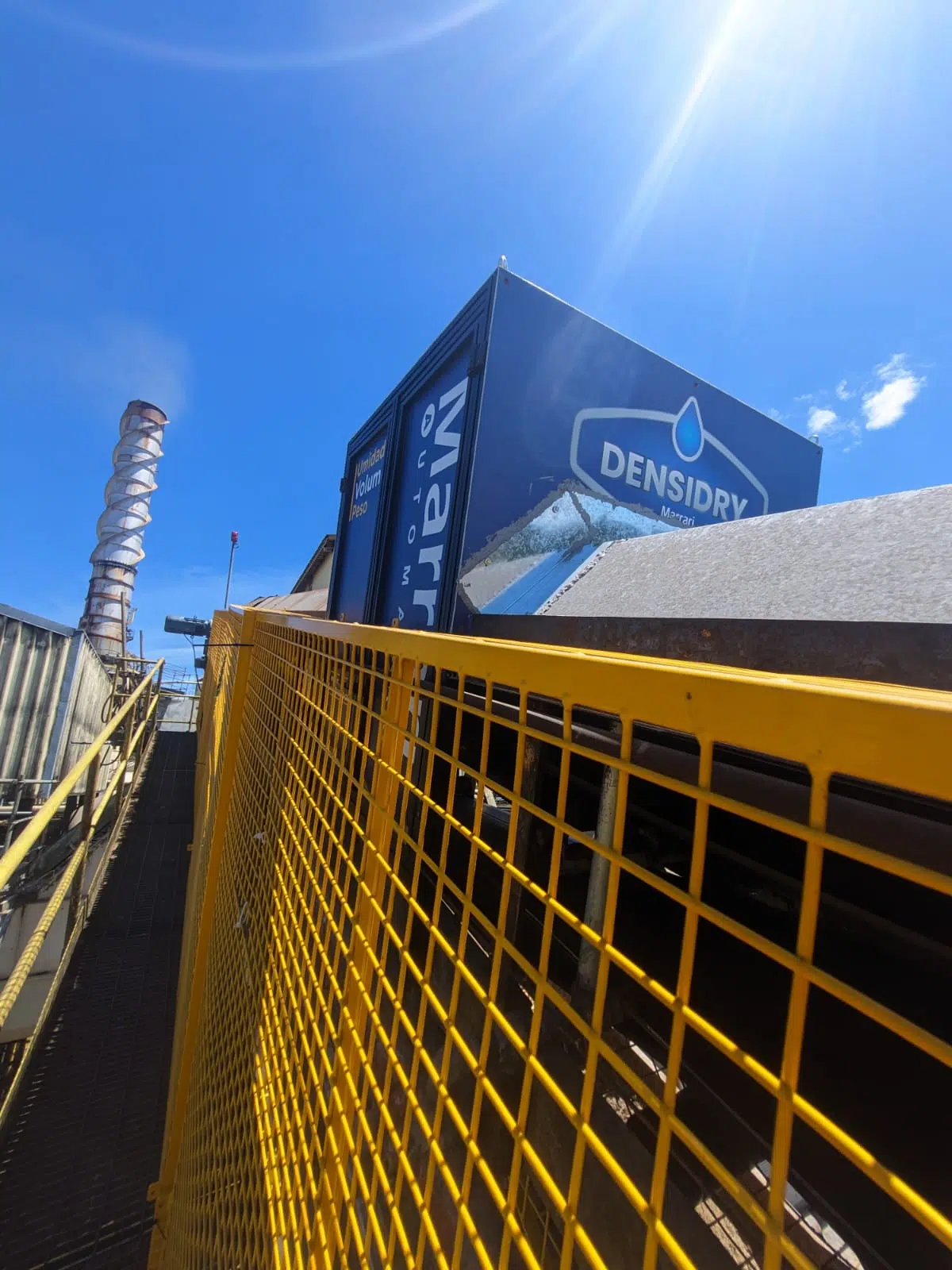
DensiDry: integrated biomass control system
DensiDry is an even more complete solution that provides:
- Measurement of conveyed volume (m³/h)
- Automatic mass calculation (kg/h) based on bulk density
- Biomass moisture measurement
- Reports and history for production control and inventory planning.
DensiDry also provides strategic information to:
- Rate biomass suppliers by the quality they deliver.
- Optimize purchasing and logistics routines.
- Improve energy inventory management.
M75: biomass moisture meter
Although the focus here is density, it is worth noting that moisture directly affects biomass mass. The M75 is a portable moisture meter for biomass loads and an excellent tool for inspecting incoming material.
Bulk density in practice: results you will notice
- Lower biomass consumption for the same energy output
- Less time adjusting combustion when biomass batches change
- More stable steam production
- Savings on transport and storage
- Better quality control of fuel bought from outside suppliers
- Support for sustainable process certification (ESG)
Conclusion
Biomass bulk density is much more than a theoretical concept: it directly affects the company’s costs, the productivity of the operation and the boiler operator’s routine. Controlling it, along with moisture, is essential for energy efficiency, operational safety and profitability.
By adopting technologies such as Marrari Automação’s M75D and DensiDry system, your plant gains much more than measurements: it gains operational intelligence and strategic control over its main energy input.
Knowing the biomass you use is the first step to getting the most out of it. Control and quality start with measurement.
Want to apply this in your plant?
Talk to a Marrari specialist on WhatsApp or see the right solution for your process.