High demand for energy, especially renewable energy, has led industries to look at sources that until recently were not considered viable. This shift is driven by environmental concerns, the need to diversify energy mixes and the pursuit of sustainability.
In this context, biomass use for energy stands out and keeps growing year after year. That growth brings the need to assess the energy potential of different types of biomass in order to optimize their use and efficiency.
The energy potential of biomass
The energy potential of biomass depends on several factors, the two main ones being the type of biomass and its moisture content. Biomass can be classified in several ways, such as agricultural, forestry, industrial and even urban residues. Each type has its own characteristics that directly affect its ability to generate energy.
Moisture is crucial because the water in the biomass absorbs part of the energy during combustion, lowering energy yield. That is why lower-moisture biomass is preferred for energy use.
Beyond these two factors, other aspects also affect energy potential, notably ash content and particle size. Ash content is the amount of non-combustible solids left after combustion, which can affect energy efficiency and residue handling.
Particle size can influence combustion efficiency and the design of boiler firing systems, for example.
How to calculate a material’s calorific value
A biomass’s energy capacity is usually quantified by its HHV (higher heating value), which represents the energy the material can deliver when completely dry, that is, at 0% moisture. This value is key for comparing and selecting different types of biomass. Here are HHV examples for some common materials in the Brazilian market:
- Eucalyptus sp.: 4,525 kcal/kg
- Pinus sp.: 4,790 kcal/kg
- Sugarcane bagasse: 3,700 kcal/kg
- Rice husk: 3,786 kcal/kg
- Coconut husk: 4,000 kcal/kg
These values show how energy potential varies between biomass types and why choosing the right material for each plant’s needs matters.
Eucalyptus, for example, is widely used because of its high HHV, while sugarcane bagasse is a valuable option in the sugar and ethanol industry, making use of residues from the process itself. Analyzing these values in detail is essential to optimize biomass as a renewable energy source.
The chart below shows how calorific value changes with the material’s moisture content:
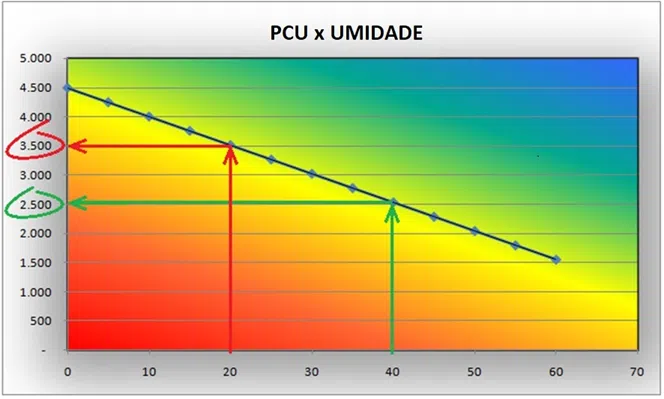
To illustrate the impact of moisture, take the list above adjusted to 40% moisture content (approximate values):
- Eucalyptus sp.: 2,287 kcal/kg
- Pinus sp.: 2,442 kcal/kg
- Sugarcane bagasse: 1,808 kcal/kg
- Rice husk: 1,859 kcal/kg
For biomass to burn, the water it contains must evaporate before the material can burn completely. Part of the energy released at the start of combustion is therefore used to dry the rest of the biomass. This is why high moisture content significantly reduces energy yield.
Besides the water initially present, combustion also forms water from the hydrogen in the fuel. Biomass typically contains about 6% hydrogen, which affects how much additional water forms during burning.
Methods for calculating the net calorific value of biomass
With these considerations, we can calculate the net calorific value as received (the usable value), which depends on the biomass’s moisture and hydrogen content. There are two main ways to determine moisture and, from it, the net calorific value of a material:
Method 1: drying a sample to constant weight
- Sampling: take a representative sample of the material.
- Initial weighing: weigh the sample before drying.
- Drying: dry the sample to constant weight (in an oven at 105 °C, per ISO 18134, without exceeding that temperature so the biomass does not decompose).
- Moisture calculation: use MCwb = ((Ww − Wd) / Ww) × 100, where Ww is the wet weight and Wd the dry weight of the sample.
- LHV calculation: apply the appropriate equation to obtain the lower heating value.
- Net value calculation: from the LHV, taking moisture and hydrogen into account, apply the equation for the net calorific value as received.
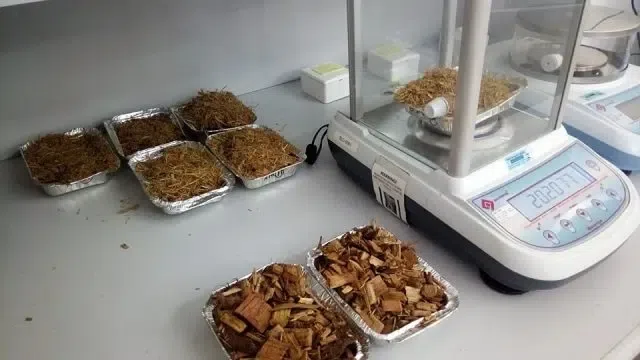
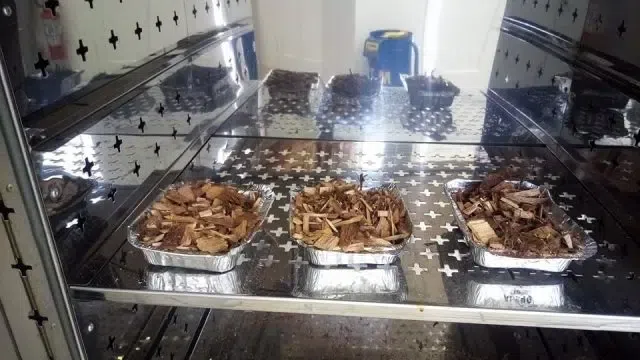
Method 2: using a biomass moisture meter
- Load the sample: place the sample in the moisture meter’s container (preferably one with good sampling, such as the M75).
- Read the values: the meter instantly displays moisture content and net calorific value.
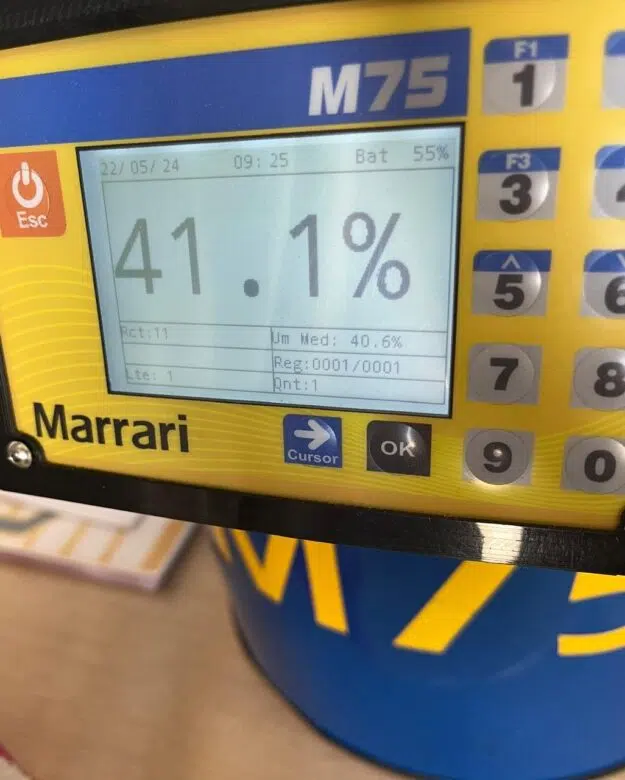
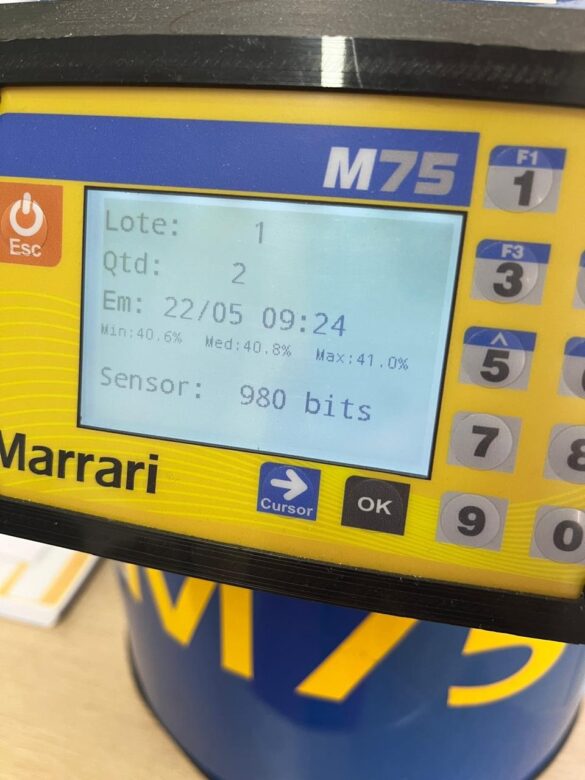
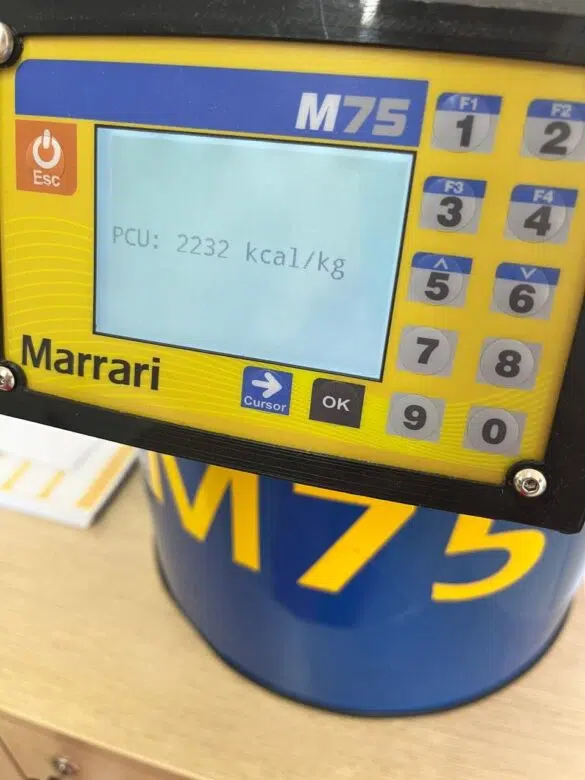
Drying to constant weight is more laborious and slower but gives accurate results. A moisture meter is fast and convenient, ideal for frequent and field measurements. The choice depends on the accuracy and speed each situation requires.
Each method has pros and cons. The table below summarizes some of them:
| Oven-dry weight | Electronic meter | |
| Time to result | Hours (6 to 12 h) | Instant |
| Sample size | Small (0.2 to 0.5 kg) | Large (8 to 10 kg) |
| Calculations | 3 equations | – |
| Auxiliary equipment | Scale + oven | – |
| Portability | No | Yes |
| Data logging | No | Yes, automatic |
| Reports and charts | No | Yes |
| Data available online | No | Yes |
| Equipment cost | Medium | Medium |
| Operating cost | High | Low |
| Primary method | Yes | No |
See how to measure with a moisture meter (video in Portuguese):

Conclusions
The advantages of using a moisture meter to analyze biofuels are clear compared with the traditional oven-drying method. Biomass moisture meters are fast, giving instant moisture and net calorific value readings, which is extremely useful when speed matters, such as assessing biomass in the field or in continuous industrial processes.
Meters are also practical and easy to use. They require no extensive sample preparation and no long wait for drying, so more samples can be analyzed in less time, improving quality control and biofuel management.
On the other hand, oven drying remains indispensable. As the primary method, it is essential for accurate, reliable measurement, because it is used to calibrate moisture meters for any type of biomass.
Calibration matters because each type of biomass has different composition and physical properties that affect electronic moisture measurement. Density, porosity and chemical composition vary between eucalyptus wood, sugarcane bagasse and rice husk, for example. Oven drying provides a highly accurate reference value so electronic meters can be adjusted for these differences.
Combining both methods, moisture meters for fast analysis and oven drying for calibration, is therefore a complete, effective approach to assessing biomass moisture and calorific value, maximizing operational efficiency without sacrificing accuracy.
Get a free biomass assessment for more efficiency and savings
Marrari offers a free assessment for companies that generate power and steam from biomass, showing how to use it as efficiently and economically as possible, with solutions, methods and ideas to improve your process.
Want to apply this in your plant?
Talk to a Marrari specialist on WhatsApp to book your assessment or see the right solution for your process.