A reel that warps in the shipping area. A batch of corrugated board that bulges after the boxes are closed. A print run that stops because the sheet picked up too much moisture in storage. Anyone working in paper and board production or quality control has seen these symptoms, even if they are not always traced back to the same root cause: poor paper moisture control along the process.
Paper is a hygroscopic material. It constantly exchanges water with the surrounding air, absorbing it in humid environments and releasing it in dry ones until it reaches equilibrium with ambient conditions. This behavior comes from the very nature of cellulose fiber. The problem starts when that equilibrium varies more than the process and the end customer can tolerate, and that is the point where paper moisture control starts to define the outcome of production. For the fundamentals, see also why and how to measure moisture in paper production.
The real problem: when paper moisture control fails
In practice, moisture variation costs money at several points in the chain, often without the root cause being obvious to whoever is dealing with the symptom.
Impact on product quality
Paper with higher moisture than expected tends to lose stiffness and is prone to waviness, curl and blistering in offset printing, because the vapor generated by the heat of the print dryer cannot escape fast enough. Paper that is too dry becomes brittle, builds up static and tears more easily as it runs through rollers and cutting knives. In corrugated board, a moisture imbalance between the layers weakens bonding and reduces crush resistance, which is exactly the property the packaging must deliver during transport.
Impact on operating costs
Every machine stop to fix a runnability problem costs downtime, rework and, in the worst cases, a web break. Batches outside the specified moisture range also lead to customer rejections, a sensitive issue for tissue and food packaging papers, where specifications are usually strict. Then there is the energy cost of drying: any steam or temperature adjustment made to compensate for a moisture deviation that should have been corrected earlier is energy spent without adding value to the product.
As a reference for typical working ranges, a few real examples from industry data sheets show the order of magnitude usually specified:
| Paper grade | Specified moisture range | Source |
|---|---|---|
| Kraft liner for packaging | 6.5% to 9% | Palm Kraft data sheet [4] |
| Paper towel / tissue (base paper) | 6% to 8% | PSA Industrial de Papel data sheet [5] |
| Folding boxboard (FBB), up to 300 g/m² | 6% to 7% | BIS technical specification [6] |
| Offset paper (reference test condition) | Tested at 23 °C / 50% RH | Suzano data sheet [7] |
Each manufacturer sets its own specification, so these figures are a starting point for comparison, not a universal rule. The actual range for each line should be validated with the lab and with customer requirements.
What the standards say about paper moisture measurement
Determining the moisture content of paper, board and corrugated board is standardized by ISO 287:2017, which describes the oven-drying method [1]. In the United States, the corresponding method is TAPPI T 412 om-22 [3]. Sample conditioning before testing follows ISO 187, which defines the standard reference atmosphere (23 °C ± 1 °C and 50% ± 2% relative humidity) used in the lab for virtually all physical tests on paper and board [2].
The oven method is reliable, but it has a major practical limitation: the result is only available after the sample has dried completely, which takes time. It works well for quality reports and audits, but not for real-time decisions on the production floor. By the time the lab result arrives, the entire batch has already gone through the machine with whatever moisture it had.
Why manual sampling does not solve the problem
The most common workaround is periodic manual sampling: take a few sheets or a piece of the reel, measure them and assume that point represents the whole batch. This leaves two gaps open.
The first is the time between samples. If the moisture of the raw material or the ambient conditions changes between two samples, nobody notices until the next control point, and whatever passed in that interval has already moved on. The second is representativeness. A paper sheet can have a different moisture profile across its width, and an isolated sample does not show that cross-direction variation.
How UmiPaper delivers in-line paper moisture control
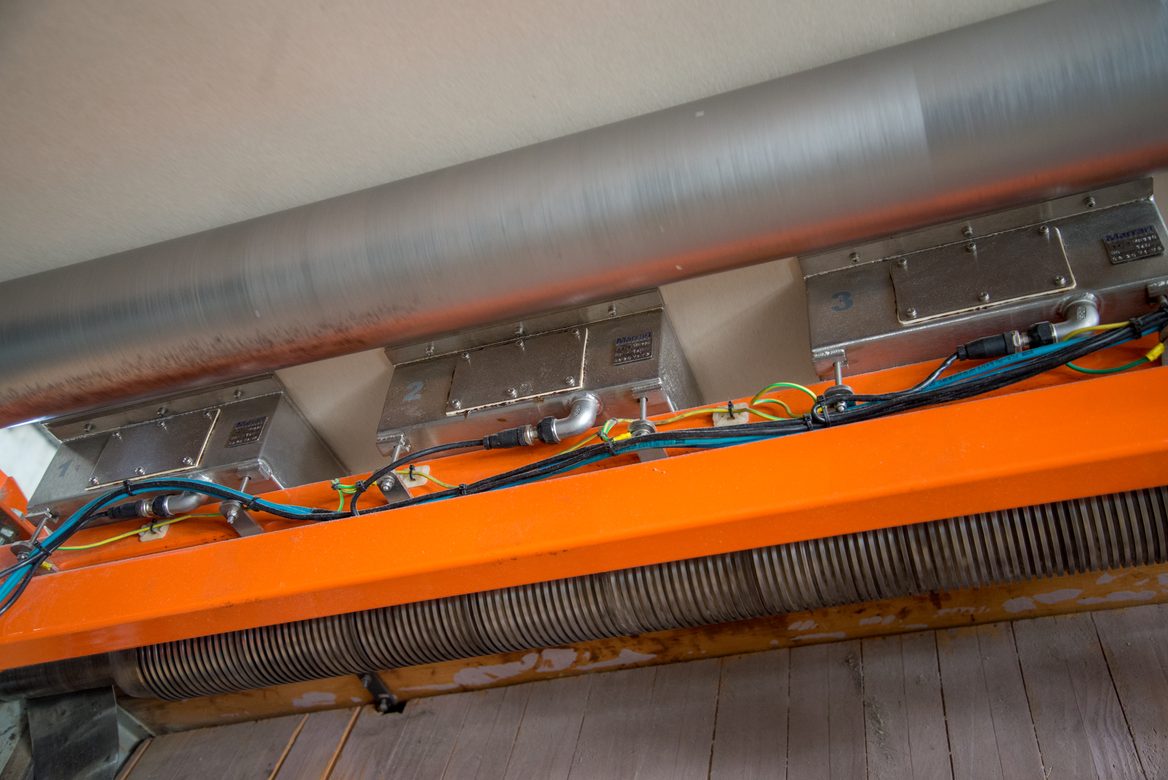
Marrari has been developing moisture measurement equipment for more than three decades, with a solid track record in the wood industry through the UmiLine line. UmiPaper, the in-line moisture meter for paper, is built on the same technology base, adapted for paper, board and cardboard, with one key difference from manual sampling: it measures in-line, directly on the production conveyor, with fixed sensors.
How the measurement works
UmiPaper uses the capacitive principle, the same technology used in all Marrari meters and sensors, which provides faster and more accurate readings than the resistance method. The sensors are installed on the conveyor, above or below the sheet, and the material passes over (or under) them during production. Several times per second (up to 20 readings per sensor), the system captures the moisture of the product at that point, delivering a real, continuous measurement rather than an isolated spot sample [8].
The included software allows calibration based on the paper actually passing over the sensor: the device records the raw value (in BITs) of each reading and correlates it with lab measurements, so UmiPaper becomes more accurate with every calibration.
Technical specifications
| Feature | Specification |
|---|---|
| Measuring principle | Capacitive |
| Reading frequency | 20 readings per second, per sensor |
| Sensors per HMI | Up to 16 |
| Calibratable paper grades | Up to 100 |
| Communication | RS-485 between sensors and HMI, with analog or digital output |
| Position on the line | Above or below the sheet |
| System | Modular, with temporary sensor standardization |
| Displayed data | Instant value of each sensor and average values |
| Add-on module | Tracker Module |
| Operational protection | Automatic sensor retraction in case of a sheet break |
Source: UmiPaper technical specifications [8].
What changes in daily operation
With continuous readings and sensors distributed across the width of the sheet, operators see moisture variation the moment it happens, not only after the lab processes a sample. The modular system and RS-485 communication with the HMI make it possible to follow each point individually or the line average, and automatic retraction in case of a break protects the equipment without manual intervention. In practice, this means acting on a moisture deviation before it turns into a machine break, warped packaging or a returned batch.
Results in practice
A process that monitors paper moisture in real time, directly on the line, instead of relying only on occasional sampling or a late lab report, has fewer unplanned stops, fewer batches rejected for being out of specification and more predictable drying energy consumption. The standard remains the reference for the formal quality report. In-line paper moisture control is what makes it possible to act before the problem shows up in the finished product.
References
[1] ISO 287:2017, “Paper and board — Determination of moisture content of a lot — Oven-drying method”. https://www.iso.org/standard/69063.html
[2] ISO 187:2022, “Paper, board and pulps — Standard atmosphere for conditioning and testing and procedure for monitoring the atmosphere and conditioning of samples”. https://www.iso.org/standard/80311.html
[3] TAPPI T 412 om-22, “Moisture in pulp, paper and paperboard”. TAPPI Standards and Methods. https://www.tappi.org/publications-standards/standards-methods/
[4] Papierfabrik Palm, Palm Kraft data sheet (moisture 6.5% to 9%, conditioning per ISO 187). https://www.palm.de/fileadmin/Papier/Wellpappenrohpapiere/Palm_Kraft_EN.pdf
[5] PSA Industrial de Papel, interfolded paper towel data sheet (moisture 6% to 8%). https://ticket.fabesul.com.br/catalogo/25372-FICHA.pdf
[6] Bureau of Indian Standards, FBB folding boxboard technical specification, moisture per TAPPI T 412. https://services.bis.gov.in/tmp/14873_05122024163219_8.pdf
[7] Suzano, Reciclato offset paper data sheet (test conditioning at 23 °C / 50% RH per ISO 187). https://fabesul.com.br/HabilB2B/Catalogo/15904-FICHA.pdf
[8] UmiPaper technical specifications (capacitive sensor, 20 readings per second, up to 16 sensors per HMI, RS-485 communication, up to 100 calibratable paper grades). Marrari Automação internal technical documentation.