
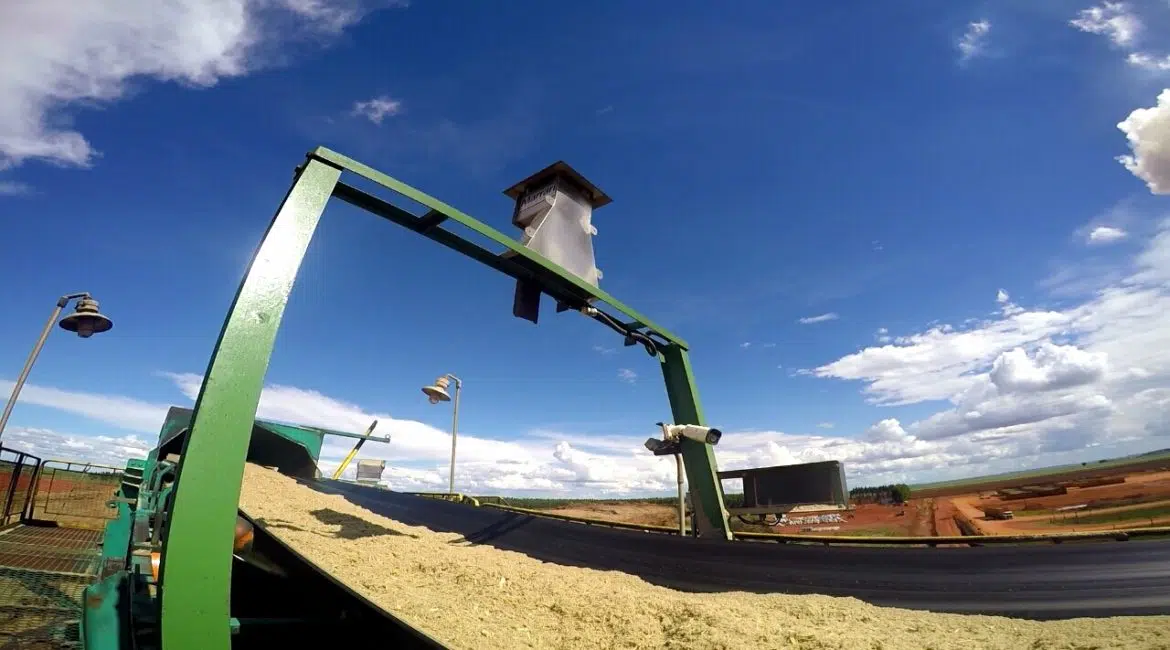
Measuring the volume of bulk materials on conveyor belts offers many advantages over traditional methods such as belt scales (weighing integrators) with load cells. The main ones are:
- Easy installation;
- Operational robustness;
- Accurate measurement of products of any density (sugarcane straw, bagasse, ore, biomass, etc.);
- Accuracy unaffected by variations in conveyor load.
Why measure the amount of material on conveyors
Knowing the amount of material matters in any industrial process. Proof of this is the wide range of solutions available: truck scales, flow scales, belt scales, static weighing, dynamic weighing, nuclear (radioisotope) scales and many other options for all kinds of situations. Each option has pros and cons that must be weighed to reach the best solution, considering:
- capacity;
- cost;
- accuracy;
- maintenance;
- calibration frequency;
- ease of installation.
Limitations of load-cell weighing
This article focuses on applications where materials moving on conveyor belts need to be quantified. In these cases, the traditional solution is weighing with load cells installed under the belt’s idler structure. The difficulties of this approach are mechanical and related to the amount of product conveyed. Load cells require special, dynamically balanced idlers; the mechanical structure must not deform as the load varies; the weight of material along the belt must be much greater than the weight of the belt and supports; and belt tension must not affect the pressure on the idlers. In addition, vibrations can be read as changes in load weight. In short, a series of conditions can drastically affect the performance of the system.
Volume measurement with the Volume X line
An innovative alternative is to measure the VOLUME of material conveyed. Volume X meters can be used on belt conveyors of any width and on drag chain (redler) conveyors. These are some of the advantages of volume measurement:
- No balanced idlers required;
- Load on the mechanical structure does not affect system performance;
- No minimum load on the belt: the scanner takes accurate readings even with small loads;
- Belt tension does not affect readings;
- Immune to system vibration;
- Measures low-density materials;
- Measures high-density materials;
- Sudden changes in the amount of material do not affect performance.
These features make volume meters much easier to apply.
Applications of volume measurement on conveyors
Applications are wide-ranging:
- Volume of biomass fed to boilers;
- Volume of sugarcane bagasse at the mill outlet;
- Volume of minerals in the cement industry;
- Volume of chopped sugarcane straw;
- Volume of grain (soybeans, corn, etc.);
- Volume of shredded cane at the mill inlet;
- Volume of mineral components in the fertilizer industry;
- Volume of ore in iron, manganese and limestone mines, etc.;
- Volume of sugarcane bagasse to calculate consumption and inventory at cogeneration plants;
- Volume of wood chips in the pulp and paper industry, including chip density calculation.
See some examples below and ask us about your application.


Author: Celso Martini, Sales Director at Marrari Automação
Want to apply this in your plant?
Talk to a Marrari specialist on WhatsApp or see the right solution for your process.