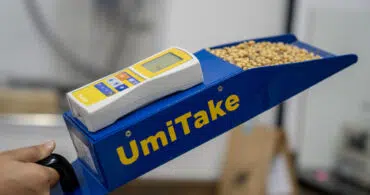

Accurate moisture measurement of grains and seeds plays a key role in agriculture and agribusiness. The right moisture content is essential for quality, proper storage and efficient marketing. When choosing a measurement method, it is important to consider how effective and accurate the results are. In this article we explain why the capacitive in-line measurement method for grains and seeds is more efficient and representative for process control than traditional benchtop moisture analyzers.
What is the capacitive in-line measurement method?
The capacitive in-line method measures grain and seed moisture continuously and in real time during processing. It is based on the material’s dielectric constant: because water has a much higher dielectric constant than dry matter, grain moisture changes the sensor’s capacitance. Capacitive sensors measure these changes and correlate them with moisture content.
Why is the capacitive in-line method more efficient for the process?
- Continuous, real-time measurement: Unlike benchtop analyzers, which give spot results, the capacitive in-line method measures continuously and in real time. This allows constant monitoring of moisture changes throughout production, and quick detection of fluctuations makes it possible to adjust parameters and correct immediately.
- Less time and cost: Benchtop analyzers require samples to be collected by hand, taken to a lab and processed one by one, which takes significant time and resources. The in-line method removes sampling and speeds up measurement, saving time and operating costs.
- Representative measurements: With benchtop analyzers you have to pick samples that represent the whole load, which can lead to variations and inaccuracies, especially when the grain is heterogeneous. The in-line method overcomes this by measuring, in real time, all the grain flowing past the sensor.
- Suited to industrial processes: Benchtop analyzers are better suited to laboratory work, small-scale quality control and as a reference for calibration. For large-scale industrial processes, the in-line method is more effective: it integrates directly into the line and measures continuously and automatically without interrupting the workflow.
- Fewer human errors: Benchtop analyzers are prone to human error during sample collection and processing. With the in-line method, measurement is automatic and does not depend on manual handling, reducing errors and increasing reliability.
Conclusion
In the grain and seed industry, accurate moisture measurement is essential to ensure final product quality. The capacitive in-line method outperforms traditional benchtop analyzers in efficiency and representativeness for process control: it measures continuously, cuts time and cost, is representative, suits industrial processes and minimizes human error. Implementing it improves moisture management, operational efficiency and product quality.
Want to apply this in your plant?
Talk to a Marrari specialist on WhatsApp or see the right solution for your process.