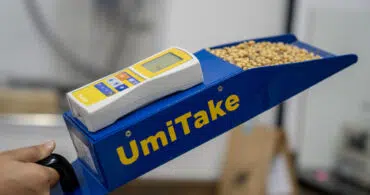

Accurate moisture measurement is critical for maintaining grain quality during storage and transport. Improper moisture leads to spoilage, mold growth and loss of economic value. In this context, real-time moisture measurement, particularly in-line dielectric measurement, stands out for its accuracy and efficiency.
The role of moisture in grain quality
Moisture is one of the main factors affecting grain quality. Improper moisture levels can cause problems such as:
- Spoilage: high-moisture grain is more vulnerable to microorganisms such as mold and bacteria.
- Weight loss: overdrying causes weight loss, reducing economic yield.
- Processing problems: grain at the wrong moisture causes difficulties in processing and milling.
Types of moisture measurement
Several moisture measurement methods are used in the grain industry, including:
- Gravimetric methods: weigh the grain before and after oven drying. They are accurate but slow and impractical for real-time measurement.
- Simple capacitive (dielectric) meters: measure moisture from the change in capacitance caused by water in the grain, that is, from the dielectric constant. They are fast, but the simplest models, with small samples and little compensation, are affected by grain density, temperature and composition.
- Resistive sensors: use electrical resistance to determine moisture. They work, but accuracy can be affected by temperature and grain conductivity.

Real-time moisture measurement with dielectric technology
In-line dielectric measurement is an advanced solution for accurate real-time grain moisture measurement. It uses the same principle as capacitive meters, the grain’s dielectric constant, which varies with water content, but measures the grain flow continuously, with temperature compensation and calibration for each type of grain.
Benefits of in-line dielectric measurement:
- High accuracy: the dielectric constant is a highly accurate indicator of moisture content.
- Fast response: instant readings make continuous monitoring during processing and storage easy.
- Less influence from external factors: with temperature compensation and product-specific calibration, it is less affected by temperature and grain composition than simple capacitive and resistive meters.


Application example
Picture a corn storage facility with in-line dielectric measurement at the dryer inlet and outlet. These sensors provide real-time grain moisture data, allowing immediate adjustments to aeration and drying to keep moisture at ideal levels. This prevents spoilage and optimizes energy use, saving money and supporting sustainability.
Video (in Portuguese):

Comparison with other methods
| Feature | In-line dielectric measurement | Simple capacitive meters | Resistive sensors | Gravimetric methods |
|---|---|---|---|---|
| Accuracy | High | Moderate | Moderate | High |
| Response time | Instant | Fast | Fast | Slow |
| Temperature influence | Low | Moderate | High | Low |
| Cost | Moderate | Low | Low | High |
Application examples (illustrative)
Example 1: grain drying
Consider a cooperative that installs in-line dielectric measurement on its corn dryer. Without real-time measurement, overdrying and underdrying are common, causing quality and weight losses. With moisture monitored at the dryer inlet and outlet, drying parameters are adjusted as needed, reducing losses and improving final product quality.
Example 2: grain storage
In a large wheat warehouse, dielectric measurement during grain handling allows tighter moisture control over long storage periods. Without it, moisture variations lead to mold growth and spoilage. With measurement in place, aeration can be adjusted continuously, keeping moisture at optimal levels and preserving wheat quality until sale.
See also the differences between methods and types of dielectric sensors (video in Portuguese):

Best practices for implementing dielectric measurement
- Strategic sensor placement: install sensors at critical points such as dryer and silo inlets and outlets for accurate, representative readings.
- Automation integration: connect sensors to control systems for immediate adjustments to aeration and drying.
- Regular calibration: calibrate periodically to maintain accuracy, adjusting curves for each type of grain.
- Data analysis: use software to track moisture trends over time and act before problems arise.
Conclusion
Accurate grain moisture measurement is essential for protecting quality and economic value. In-line dielectric measurement, like our UmiGrain system, offers high accuracy and fast response, making it an advanced, efficient technology for real-time monitoring with clear advantages over other methods.
With it, companies protect product quality, optimize processes and cut costs, building a more sustainable and profitable supply chain.
Want to apply this in your plant?
Talk to a Marrari specialist on WhatsApp or see the right solution for your process.