

A SCADA (Supervisory Control and Data Acquisition) system is software that connects to a range of equipment on the shop floor to supervise and control processes. Modern platforms such as Marrari’s PSi4 are modular and built on Industry 4.0 concepts. The interface works by connecting to this equipment, usually PLCs (programmable logic controllers), through which a wide range of data can be gathered.
SCADA is used to track process steps, configure and store information and provide resources for manual or automatic intervention. Besides collecting data, it allows information to be visualized and supervised and performance reports to be created.
Supervisory systems use equipment, sensors, drivers, servers and actuators that control the processes of an industrial plant in any sector. Examples of variables that SCADA analyses and controls include pressure, flow, temperature, level, voltage, weight, moisture and current.
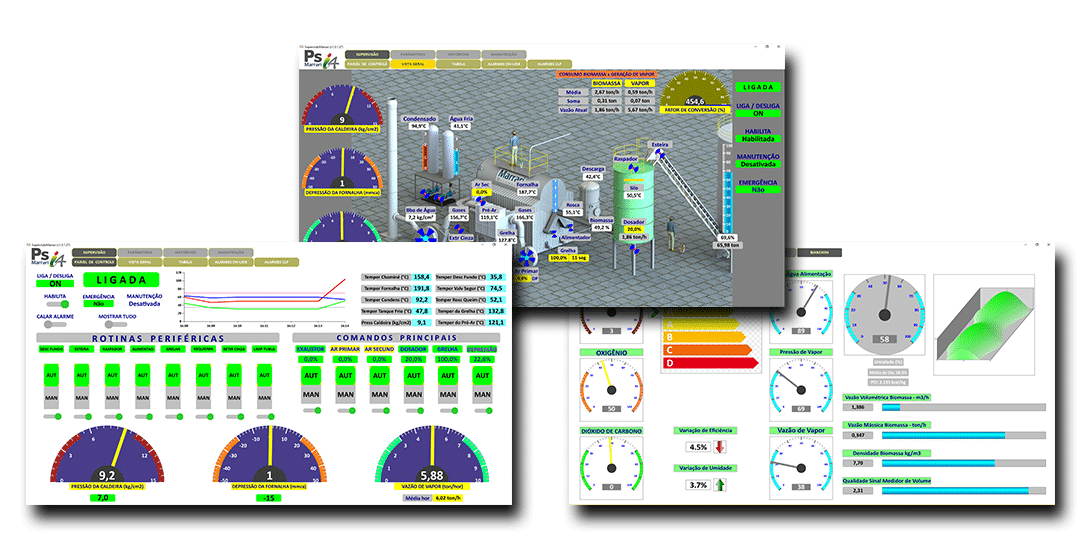
In addition, modern SCADA systems can incorporate machine learning techniques that help predict machinery failures, avoid production stoppages, reduce electricity use and cut material waste through fine control.
How it works in practice
To illustrate what a SCADA system is and how it works, try this exercise: imagine a factory making tools for the construction industry, with a machine that switches on a light every time it finishes a part, to tell the operator the process is complete. This simple but effective circuit illustrates the basic principle of supervision: keeping the operator informed about the state of the process.
Today, with advances in technology and Industry 4.0, far more complex systems are available that can monitor many devices automatically and remotely.
SCADA applications
Around the world, SCADA systems are found in countless applications and industrial sectors, from timber to food, as well as power plants, where SCADA detects line current and voltage, monitors protection and switching devices and can trip circuits when needed. It also controls generators, turbines and the electricity produced.
SCADA systems are also used in water and wastewater treatment plants, in industrial steam and power boilers, in building and home automation, and to manage multiple machines on a single screen.
In manufacturing, these systems are widely used for production management and for inventory control in just-in-time production, regulating automated equipment and robots and monitoring the process and quality.
SCADA in the public sector too
It would be a mistake to think SCADA is only used by private companies. Many city governments, in Brazil and abroad, use process supervision systems to tackle urban mobility problems: systems that help regulate power for metros, trains and buses, automate metro cars and, of course, manage smart traffic lights at intersections across the city.
Conclusion
If you are a manager or even the CEO of a plant that needs to automate and save time and money, SCADA process supervision systems are just what the doctor ordered: they are agile and intuitive and make smarter use of human capital, with a focus on reducing failures and production bottlenecks. See Marrari’s software solutions.
Want to apply this in your plant?
Talk to a Marrari specialist on WhatsApp or see the right solution for your process.