For industrial boilers, efficiency, productivity, cost reduction and energy generation are key topics. Most industrial processes need thermal energy for a wide range of purposes.
The most common generators for this are steam boilers, used in small processes (heating water for a hotel or laundry, for example), medium-sized ones (food industry, wood drying, meatpacking plants, etc.) and very large processes where, in addition to thermal energy for the industrial process, electricity is cogenerated with turbines (pulp and paper mills and sugar and ethanol plants, among others).
Whatever the size of the boiler, the goal is the same: make the most of the fuel. Below are some considerations for a medium-sized boiler burning biomass.
The effect of fuel moisture
Boiler efficiency obviously depends on several factors: the boiler design, its devices (economizer, grate type, etc.) and external resources (condensate recovery, for example), among others. Here we look only at the influence of fuel moisture content. For this, the boiler control system must be able to process this information and adjust some boiler settings to make the most of the fuel. If your boiler control system cannot do this, see EcoSteam, Marrari’s boiler control solution.
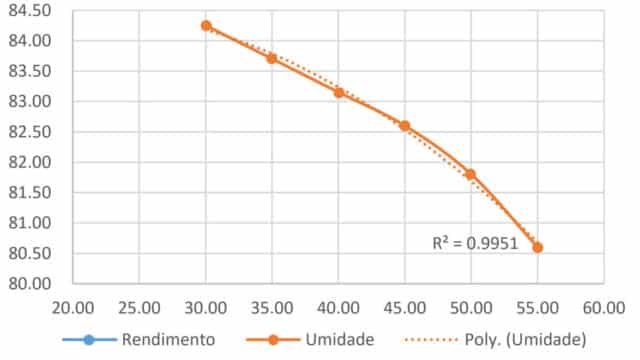
See the chart below. It is a typical efficiency curve for a medium-sized boiler (15 to 40 t of steam per hour and pressure up to 20 kg/cm²).
Example: a 30 t/h steam boiler
Consider a boiler that produces 30 t of steam per hour and is well tuned for maximum efficiency with fuel at 40% moisture.
Under these conditions, boiler efficiency is 83.15%, using about 0.4 t of biomass to produce 1 t of steam. That means a consumption of 288 t of biomass per day.
Now suppose biomass moisture rises to 45% (on average over the day). If the boiler is not adjusted to this new condition, its efficiency drops to 82.61% and it will burn about 290 t of biomass per day. Over a year, this difference adds up to roughly 700 t of extra biomass. This calculation only considers the drop in boiler efficiency; in practice, wetter biomass also has a lower calorific value per tonne, which increases consumption even further.
It is easy to see that investments in better biomass use deliver significant results and a very attractive payback.
How to make better use of the fuel
What can you do? Simple: measure the moisture content and volume of the fuel going into the boiler. With this information feeding the boiler controller, and the controller acting on the settings (primary air, secondary air, furnace pressure, grate movement, draft, etc.), you ensure maximum fuel use, with significant gains like those shown above.
Author: Celso Martini, Eng., Sales Director at Marrari Automação
Want to apply this in your plant?
Talk to a Marrari specialist on WhatsApp or see the right solution for your process.