In wood drying, accurate moisture control is crucial for a high-quality final product. For decades, sensor pins have been the traditional way to measure wood moisture in drying kilns. Yet despite their wide use, they have significant drawbacks that affect both wood integrity and drying efficiency.
In this article, we look at the main problems with sensor pins and how a solution such as Marrari Automação’s UmiPack removes them, improving moisture control in the wood industry.
What are sensor pins and how do they work?
Sensor pins are metal needles driven directly into the wood to measure its moisture during drying. They are inserted into the board surface and connected to a meter, which reads the electrical resistance between the pins and converts it into an estimate of moisture content.

This simple method has been used for decades, but technology has since produced more efficient alternatives. Although sensor pins are inexpensive and easy to install, their ongoing use has several limitations.
Problems with sensor pins in wood drying
1. Physical damage to the wood
To measure moisture, the pins must be driven into the wood, which means making holes. Besides being invasive, these holes can:
- Compromise the structural integrity of the piece.
- Leave visible marks that reduce the wood’s appearance value, especially in high-grade products.
- Encourage cracks to start at the drilled points.
2. Localized, limited measurement
Sensor pins only measure moisture where they are inserted. This means that:
- The reading is not representative of the whole load. Some parts may dry unevenly, especially inner layers that are not monitored directly.
- Controlling moisture with partial data raises the risk of underdrying or overdrying, compromising the final product.
3. Wear and maintenance
Exposed to changing heat and humidity inside the kiln, the pins wear out over time. This means:
- Regular pin replacement, raising maintenance costs.
- Declining accuracy over time, as worn pins give less reliable readings.
4. Installation work on every load
With every new load, pins must be driven in and cables connected inside the kiln. This takes crew time, and when it is done differently each time, it affects the consistency of the readings.
How UmiPack changes moisture measurement
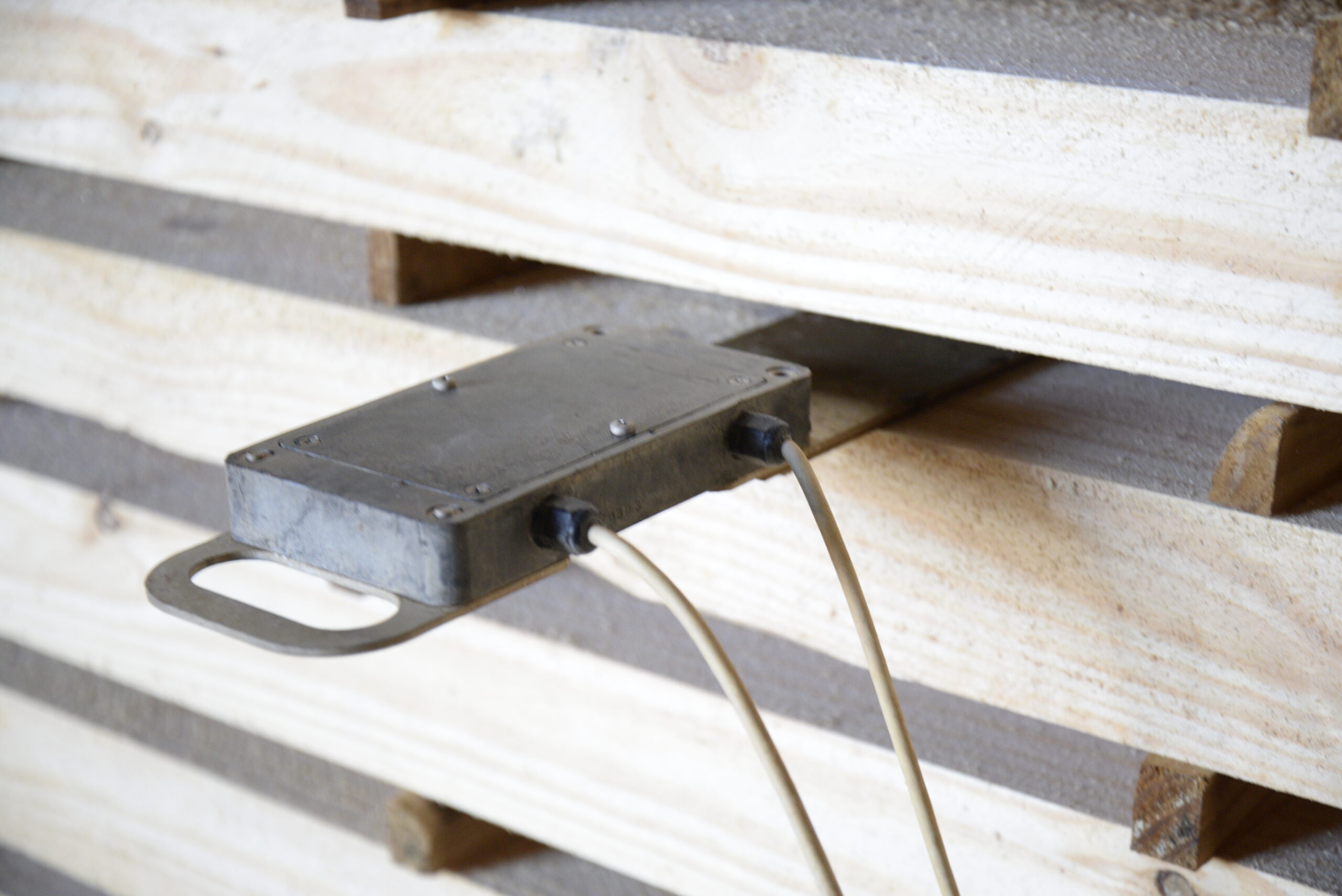
Developed by Marrari Automação, UmiPack is a modern solution that removes sensor pins from the drying process. Using dielectric technology, it measures wood moisture non-invasively through metal plates that detect the dielectric changes caused by water.


Sensor pins vs. UmiPack
Here is how sensor pins compare with technology that requires no drilling:
| Aspect | Sensor pins | Modern solution (UmiPack) |
|---|---|---|
| Invasive | Yes, requires drilling | No, non-invasive measurement |
| Measurement area | Spot (only where the pins are) | Broad (surface and interior) |
| Accuracy | Limited and localized | High and comprehensive |
| Durability | Short, needs regular replacement | High, with little or no maintenance |
| Operating cost | Higher, due to new pins | Lower, with no wear parts |
UmiPack advantages over sensor pins
- Non-invasive measurement: UmiPack does not drill into the wood, eliminating any risk of damage. This matters especially for high-grade lumber or when appearance must be preserved.
- Broad monitoring: unlike pins, which measure isolated spots, UmiPack monitors both the surface and the interior of wood stacks, giving a more complete, accurate reading and more uniform drying.
- Continuous, real-time readings: the system measures continuously throughout the process, allowing real-time adjustments. This reduces errors and improves energy efficiency.
- Lower operating costs: with UmiPack there are no pins to replace, which greatly reduces maintenance and extends the life of the measuring system.
Final thoughts
Although sensor pins have long been the standard in wood drying, their limitations (invasiveness, spot measurement and maintenance costs) make them increasingly outdated. Modern solutions such as UmiPack offer a more efficient, less invasive alternative that protects the wood and optimizes the whole drying process.
By eliminating sensor pins and adopting technologies such as UmiPack, wood companies can achieve more accurate moisture control, better product quality and lower operating costs.
Want to apply this in your plant?
Talk to a Marrari specialist on WhatsApp or see the right solution for your process.